
KYC without the friction: verification users actually complete
KYC shouldn’t be a barrier to onboarding. Discover how secure, user-friendly identity verification can reduce friction, build trust, and help more users successfully complete verification.
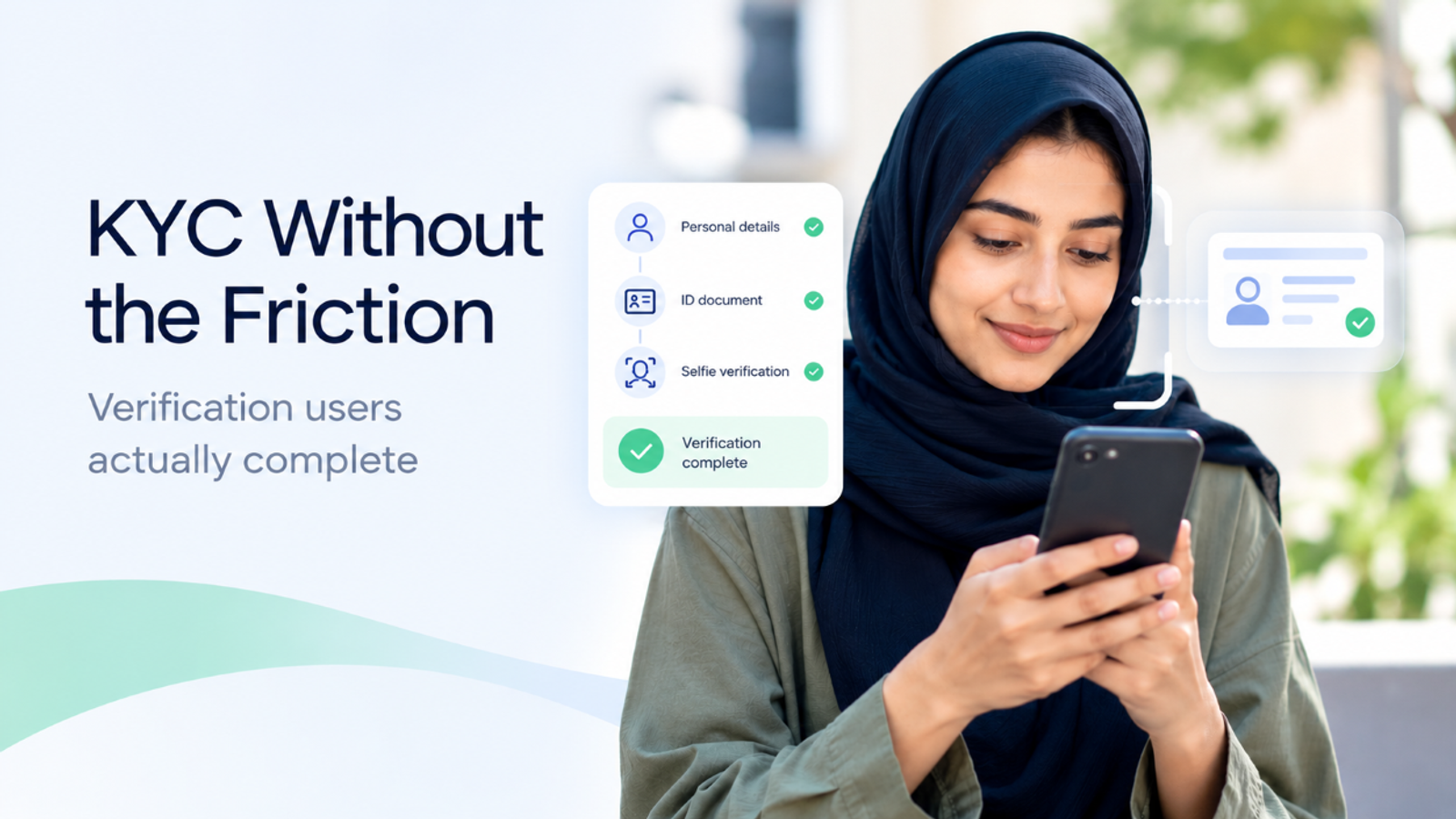
Know Your Customer (KYC) is essential to modern digital services. It protects businesses from fraud, supports regulatory compliance, and helps create safer financial ecosystems.
But there is a problem.
For many users, KYC is also the moment when onboarding becomes complicated, confusing, and frustrating.
A user may have already decided to sign up, downloaded the app, entered their details, and reached the final step, only to be asked to upload documents, take multiple photographs, complete a facial verification process, or repeat the process because something went wrong.
When verification feels like a barrier rather than part of the experience, users abandon it.
The challenge for businesses is therefore not simply to perform KYC. It is to design KYC that people actually complete.
The KYC balancing act
A good verification system has to satisfy several requirements at once.
It needs to be secure enough to identify genuine customers and prevent fraud. It needs to collect the information required for compliance. It needs to protect sensitive personal data.
At the same time, it needs to be fast, intuitive, accessible, and reliable.
These objectives can appear to be in conflict.
More security can mean more steps. More checks can mean more friction. More information can mean more opportunities for users to make mistakes.
But effective KYC does not necessarily mean adding more complexity.
It means putting the complexity where it belongs: behind the experience rather than in front of the user.
Verification should feel like part of onboarding, not a separate process
Users rarely think about KYC in the same way a compliance team does.
They are not thinking about document classification, identity assurance, risk scoring, AML requirements, or verification thresholds.
They are thinking:
- “How long will this take?”
- “What do I need to do?”
- “Why do you need this information?”
- “What happens if my document doesn't work?”
A well-designed KYC journey answers these questions before the user needs to ask them.
Instead of presenting users with a long checklist, the process should guide them through a small number of clear steps:
- Tell the user what is required.
- Capture the necessary information.
- Verify the identity.
- Explain the result.
- Move the user forward.
The objective is simple: remove uncertainty from every step.
The document capture problem
Document verification is one of the most common sources of friction.
Users may have passports, national identity cards, driving licences, or other accepted documents. But simply asking someone to “upload your ID” is not enough.
What if the image is too dark?
What if the document is partially outside the frame?
What if the user does not know which side to photograph?
What if the document is supported in one country but not another?
A better experience provides contextual guidance at the point of capture.
For example, the system can tell users where to place the document, whether all four corners are visible, and whether the image is clear enough before submission.
This turns verification from a trial-and-error process into a guided process.
Facial verification should be simple too
Face verification can introduce another layer of friction.
Users may be asked to position their face correctly, move their head, look at the camera, or repeat the process if the system cannot obtain a suitable image.
The technology behind this can be sophisticated. The user experience should not be.
A good verification journey should provide:
- Clear instructions
- Immediate feedback
- Minimal unnecessary steps
- Support for different lighting conditions
- Appropriate handling of verification failures
- A clear explanation when another attempt is required
The user should never feel as though they are being tested by the system.
They should feel guided by it.
Don't make users guess why verification failed
One of the biggest mistakes in digital KYC is providing vague error messages.
Messages such as:
“Verification failed.”
do not help the user.
Neither does:
“Invalid submission.”
The user needs to know what happened and what they should do next.
A better message might explain:
“We couldn't read your document clearly. Please retake the photo in good lighting and make sure the entire document is visible.”
The difference is small, but the impact can be significant.
Good error handling turns failure into another guided step rather than an abandonment point.
Accessibility is part of KYC
A verification process designed for an ideal user will inevitably exclude some real users.
People use different devices, have different levels of digital literacy, speak different languages, and operate in very different environments.
This is particularly important when building financial and digital identity services for emerging markets, where connectivity, device quality, and access to documentation can vary significantly.
KYC should therefore be designed around real-world conditions.
That can mean:
- Supporting multiple document types
- Designing for lower-bandwidth environments
- Providing clear multilingual instructions
- Optimising for mobile devices
- Avoiding unnecessary data entry
- Providing recovery paths when verification cannot be completed
- Making the process understandable without specialist knowledge
A secure system that users cannot successfully navigate is not an effective onboarding system.
Privacy should be visible, not just buried in the terms
Identity verification involves highly sensitive information.
Users need confidence that their documents, biometric information, and personal details are being handled responsibly.
Privacy therefore should not exist only inside a lengthy privacy policy.
The verification journey should communicate the essentials clearly:
What are you collecting?
Why are you collecting it?
How will it be used?
How will it be protected?
This transparency can make the verification process feel significantly more trustworthy.
And trust is particularly important when users are being asked to provide identity documents or biometric information to a service they may be using for the first time.
Automation should remove work, not remove control
Modern KYC systems can automate much of the verification process.
Document information can be extracted automatically. Identity documents can be checked against verification rules. Facial matching can help establish that the person presenting the document is the same person completing the verification.
Automation can make verification faster and more scalable.
But automation should not mean that users lose control of the process.
When something goes wrong, there should be an understandable path forward.
The best systems combine automation for speed with human-centred design for resilience.
KYC is not just a compliance function
It is tempting to think of KYC as something owned entirely by compliance teams.
In reality, KYC sits at the intersection of:
Compliance + Security + Technology + User Experience + Trust
A compliance team may define what information must be collected.
A security team may determine the controls required.
A technology team may build the verification infrastructure.
But the customer experiences all of these decisions as a single journey.
That means KYC needs to be designed as a product experience, not simply implemented as a regulatory requirement.
The real metric is completion
A verification system should not only be measured by whether it can identify a customer.
Businesses should also ask:
- How many users start verification?
- How many complete it?
- Where do users abandon the process?
- How often do users need to retry?
- How long does verification take?
- What percentage requires manual review?
- Which devices or environments create problems?
- Why are verification attempts failing?
These measurements reveal something important.
A technically accurate KYC system can still be a poor KYC experience.
The objective is not simply to maximise verification checks.
It is to maximise successful, secure verification with minimal unnecessary friction.
Building KYC users who actually complete
The future of digital identity verification will not be defined solely by better detection algorithms.
It will also be defined by better experiences.
The strongest KYC journeys will be:
Secure enough to protect the platform.
Simple enough for everyday users.
Flexible enough for different markets and circumstances.
Transparent enough to build trust.
Reliable enough to complete on the first attempt.
At Bawarii, we believe identity verification should enable digital services rather than stand in their way.
KYC should be something users move through, not something they struggle through.
Because the best verification experience is not the one with the most steps.
It is the one that delivers the confidence businesses need, and the simplicity users expect.